Introduction
The Samsung Galaxy Alpha is a surprising change in the Samsung product strategy. It certainly has many of the Galaxy S5 key selling features, while staking on more premium material such as aluminum. But it's not another flagship, no, it's rather an offshoot of the Galaxy family tree - something that the Galaxy S5 mini could have been but is not. A strange bird, indeed.
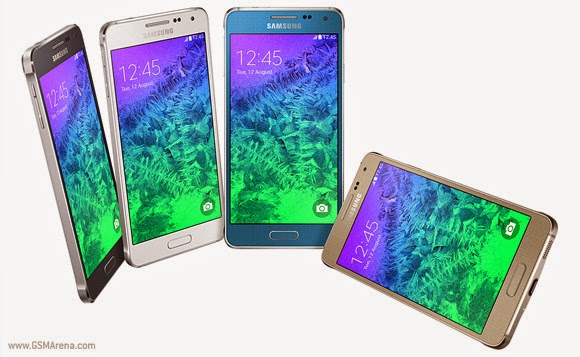
Samsung Galaxy Alpha press photos
That certainly doesn't mean we don't like it. Just on the contrary. The Samsung Galaxy Alpha presents a nice departure from the Galaxy S5 design language. The sides are machined out of aluminum, while the back no longer imitates faux leather.
The Galaxy Alpha has a smaller screen than the S5 to make it much more pocketable and also, undoubtedly, to allow it to compete with the iPhone 6 directly.
Here's what makes the Samsung Galaxy Alpha tick.
Samsung Galaxy Alpha at a glance:
General: GSM/GPRS/EDGE/UMTS/HSPA/LTE connectivity;
Form factor: Touchscreen bar phone with aluminum sides and a plastic back cover;
Dimensions: 132.4 x 65.5 x 6.7 mm, 115 g;
Display: 4.7" 720p SuperAMOLED touchscreen, 312ppi pixel density;
Chipset: Octa-core Exynos 5 Octa 5430 chipset, including a quad-core 1.8 GHz Cortex-A15 & quad-core 1.3 GHz Cortex-A7, Mali-T628 MP6 GPU
OS: Android 4.4.4 KitKat with TouchWiz;
Memory: 32GB storage, no microSD card slot;
Camera: 12MP auto-focus camera, 31mm focal length, f/2.2; LED flash;
Video camera: 2160p video recording, but also 1080p@30fps, 1080p@60fps, 720p@120fps;
Front camera: 2.1MP front-facing camera;
Connectivity: Dual-band Wi-Fi a/b/g/n, Wi-Fi hotspot, DLNA, Bluetooth 4.0, NFC, standard microUSB 2.0 port, GPS/GLONASS receiver, 3.5mm audio jack;
Battery: 1,860mAh Li-Ion removable battery;
Misc: Fingerprint sensor; heart rate sensor;
The Samsung Galaxy Alpha is surprisingly light, it feels sturdy and the back looks like it could take a lot of beating before it gets seriously scratched. The latter benefit is certainly something we've missed in high-end smartphones that we've seen lately.
Our biggest regrets in the specs department are the lack of water-proofing and the lack of a microSD card slot.
Samsung Galaxy Alpha live photos
We've got the smartphone for a few days to keep us company and we thought that we might as well come up with this quick preview of the Samsung Galaxy Alpha, so you can have something to chew on, while we are hard at work on the full review. Enjoy!
Design and build quality
Samsung's shift in design has to be felt to be believed. No, really, on the outside the Samsung Galaxy Alpha is very similar to the Galaxy S5 mini. A keen eye will notice that the bezels above and below the screen are smaller, accommodating the bigger screen. The Alpha is also considerably thinner, if that's not obvious by first look.
Of course, the major upgrade to Samsung's design language here is the metal chassis. The sides of the phone are exposed metal while the front and back are covered in glass and plastic, not unlike Apple's iPhone 4 / 4s and Sony's Xperias.
Samsung Galaxy Alpha compared to the outgoing iPhone model
The Galaxy Alpha will inevitably draw comparisons with the iPhone - the flat metal sides are segmented by thin lines of plastic and look so familiar. Samsung's design features flared corners which improve handling a bit by preventing your fingers from slipping off the rounded corner. They also remind us a bit of the Samsung Galaxy S5 Active.
The back of the phone is plastic, with the dotted pattern of perforated leather similar to the Galaxy S5 though here the pattern is finer and not resembling leather so much.
While the plastic isn't the most premium material, the Samsung Galaxy Alpha impresses with a mere 6.7mm thickness. It's the slimmest Galaxy device to date though not the slimmest smartphone in general.
The feeling of compactness is helped by the weight of 115g, few 4.7" phones weigh this little. The Galaxy Alpha feels tiny compared to the current crop of 5" flagships.
Galaxy Alpha in the hand • the flared corners slightly improve the grip
The Galaxy Alpha also compares favorably against iPhone 5s, which measures 7.6mm thick and weighs 113g. The iPhone 6 is expected to be bigger and thinner than its predecessor but it remains to be seen if Apple can keep the weight down. And it's the upcoming iPhone that Samsung has in its sights, not the 5s.
We can only suppose that the magic behing this reduced weight is the reduced battery capacity, which in this case amounts to only 1,860mAh. Indeed, the battery is removable, but it's still a measly capacity.
The front is made of glass though Samsung has not revealed yet whether it's the usual Gorilla Glass or not. Under the glass is a plastic that matches the back in terms of color and the fine dotted pattern. The Galaxy Alpha will be available in Charcoal Black, Sleek Silver, Dazzling White, Frosted Gold and Scuba Blue.
The front of the device features an earpiece, the usual sensor array (proximity,
Samsung Galaxy Alpha performance
The Samsung Galaxy Alpha is the first device with Exynos 5 Octa 5430 that we've tested. The chipset features a big.LITTLE processor with four Cortex-A16 cores and four Cortex-A7 cores clocked at 1.8GHz and 1.3GHz respectively. All eight can run simultaneously so we can expect great multi-core performance.
The chipset also packs a hexa-core Mali-T628 MP6 GPU, the latest currently available Mali design. Processor and RAM share 2GB of RAM.
The Samsung Galaxy Alpha comes with Android 4.4.4 KitKat out of the box. Note that Samsung disables the ART runtime in its TouchWiz software, that's the faster optional runtime that debuted with KitKat and will be made default in Android L. An increasing number of apps is becoming compatible with ART.
Samsung Galaxy Alpha camera quality
The Samsung Galaxy Alpha comes with a 12MP camera. Samsung hasn't had a 12MP shooter in its lineup for ages so the Alpha isn't just borrowing the camera of another Galaxy. The image sensor has 16:9 aspect ratio, meaning it shoots widescreen photos natively.
The interface has been lifted directly from the Galaxy S5. The right column holds the essential keys - still and video shutter keys, the Mode button and the gallery shortcut. The left column has the front/back camera toggle, selective focus, HDR and settings shortcut.
Samsung Galaxy Alpha camera interface
The middle two shortcuts are customizable, the top and bottom ones are not. The Mode button is the other place you can quickly access shooting modes, including Panorama, Shot & more, Virtual tour, Dual Camera and Beauty face.
Shot & more combines Best photo, Best face, Drama shot, Eraser and Panning shot. Dual Camera takes a photo with both front and back cameras simultaneously.
Virtual tour shot is similar to panoramas except you can move forward, turn left or right, move some more. Selective Focus takes two shots and processes them so you can photograph a close-up subject and blur the background or blur the object and keep the background in focus. The third option is everything in focus, here's how those options look.
Near focus • far focus • all in focus
You can download new camera modes from the Galaxy App store (like Surround shot, a spherical panorama mode).
Here are some camera samples taken with the Samsung Galaxy Alpha, we'll reserve comments on the image quality for the review.
Samsung Galaxy Alpha camera samples
And here are some HDR samples:
HDR off • HDR on
Video camera
The Samsung Galaxy Alpha joins the elite club of 2160p shooters. It can also capture 1080p video at both 30fps and 60fps and slow motion is available at 720p resolution. Note that the slowest option (8x) drops the framerate of the resulting video to 15fps, use 4x if you want to keep it at 30fps.
Options for the video camera on the Galaxy Alpha
For 2160p videos the Alpha camera records at 48Mbps bitrate, matching the Galaxy S5. Interestingly, audio recording is done at 256Kbps, double the bitrate the S5 uses and matching the venerable Nokia Lumia 1020.
Total bitrates go down from there - 28Mbps for 1080p@60fps and 17Mbps for 1080p@30fps. The audio bitrate remains unchanged.
An important thing to note is that switching to 2160p video mode puts an upper limit on video length - 4 minutes (instead of the usual 5) - and disables certain features like Dual Camera, HDR, video effects, taking photos during video capture and video effects.
First impressions
The classic rivalry has been between the Galaxy S and the iPhone but the Galaxy S also has to fight off Android flagships too. Now Samsung has introduced a phone to specifically battle the upcoming iPhone but a quick glimpse at it reveals it may pose a serious competition to the Xperia Z1 Compact, too (or whatever mini phone Sony comes up with this fall.
The exposed metal on the sides of the Galaxy Alpha gives the phone a sense or rigidity that plastic never quite manages. Even so we struggle a bit to call the Alpha a premium device - the plastic on the back and the design of the front are very much standard Galaxy affair, from mid-range to flagship.
Samsung's ubiquitous design is hurting the Alpha a bit, you have to tell the uninitiated that this isn't just another Galaxy S mini. This was perhaps a perfect opportunity for the South Korean giant to shakeup its design language.
That said, the Samsung Galaxy Alpha has proper flagship specs - the chipset is a little speed devil and the 12MP camera looks very promising. The phone also brings blazing fast connectivity, the trendy fingerprint reader and a heart rate monitor to boot.
The only place where the Alpha falters seriously in terms of specifications is the measly battery capacity and the lack of a microSD slot. We feel that engaging the Ultra Power Saving Mode might become a way of life for Alpha owners though.
We finally got what many were asking for - a metal Galaxy flagship. It's metal only on the sides but that worked well enough for iPhones, Xperias and Lumias. Whether the Galaxy Alpha can rise above its worn out looks (both hardware and TouchWiz software) and the screen/batter. For more information visit www.gsmarena.com